
Home EV Chargers
.png)
EV Home Charging in the North West:
A Simple Guide for Our Lease Customers
Thinking about an electric car on lease with leasepartner? Getting a smart home charger is the easiest way to live with an EV day to day—and it’s not as complicated as it sounds. We support drivers across the Wirral, Cheshire, Liverpool, Chester, and the wider North West, helping you choose and install the right EV charge points at home.
Quick summary
-
A home charger makes charging faster, safer, and cheaper than using a 3-pin plug.
-
Plan where the unit will go, check your Wi-Fi, choose the right charger, understand installation costs, and pick a reputable provider.
-
A typical install takes around 2–3 hours once approved.
Why fit a home charger?
Yes, you can top up from a 3-pin socket, but a dedicated unit is a game-changer:
-
3× faster than a 3-pin: a standard 7.4 kW home chargepoint will add meaningful range overnight. For large-battery EVs (100 kWh+), a 3-pin often isn’t practical for a full charge by morning.
-
Safer by design: Home units are built for continuous load with the right protections—something regular sockets weren’t designed for.
-
Smarter & cheaper to run: Schedule off-peak charging automatically, lock the charger, track costs, and (optionally) integrate with solar.
-
Set-and-forget convenience: Park, plug in, wake up to a full battery.
The top 5 things to consider before you book
-
Where you park & where the charger will go
-
Your home Wi-Fi quality
-
Which charger to choose
-
What installation will cost
-
Which chargepoint provider to use
We handle installs throughout the Wirral, Cheshire, Liverpool, Chester, and the North West—so local knowledge is on your side.
1) Where’s the best place to install an EV charger?
Most installers will look for off-street parking (driveway, garage, carport) so the cable doesn’t cross a public pavement. A good spot is:
-
Close to your usual parking position so the cable easily reaches your charge port.
-
Near a sensible cable route back to your consumer unit (shorter runs usually mean lower cost).
-
Weather-sensible: All reputable units are outdoor-rated, but a sheltered wall keeps things tidy.
Cable length & socket location (important in tight North West driveways):
-
Check the distance from where you park to the proposed charger position. Cables come in different lengths—go for a balanced length that’s easy to use and store.
-
Consider where your EV’s charging socket sits (front, rear, left, right). Placing the unit to suit your car saves daily faff.
-
Note the distance from your home’s power supply (consumer unit) to the charger location—providers have standard-install limits; longer runs can add cost.
2) Does my EV charger need Wi-Fi?
Most smart home chargers offer features that rely on connectivity:
-
Scheduling (cheap, off-peak charging)
-
Firmware updates (performance & security)
-
Usage data and remote lock/unlock
Wi-Fi is optional, but smart features are extremely useful. Ensure the charger location is within range of your router or a Wi-Fi extender. If the charger loses connection you can still charge, but the smart features may pause until it reconnects. (Some models offer Ethernet or 4G as alternatives.)
3) What kind of EV charger should you choose?
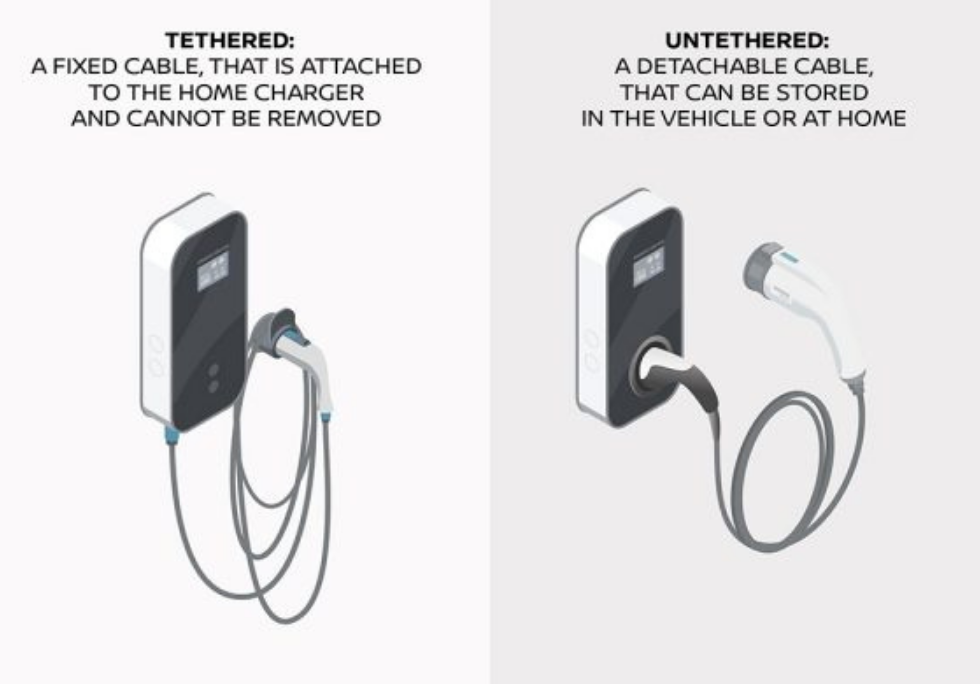
Tethered vs untethered
-
Tethered: fixed cable on the unit—grab and go. Best for daily ease.
-
Untethered: socket only—use your own Type-2 lead. Neater look, easy to change cable length later.
Charging rate: what’s actually possible
-
Maximum charging rate: Your car and charger settle at the lowest common max. Example: an EV capable of 11 kW will still charge at 7.4 kW on a 7.4 kW unit. Plugging into 22 kW won’t exceed the car’s 11 kW limit.
-
Available power supply: Almost all UK homes are single-phase, which caps AC home charging at 7.4 kW. Faster 11/22 kW needs three-phase—possible, but typically costly to upgrade.
-
If you truly need >7.4 kW at home, plan a three-phase upgrade before installation.
Good smart features to look for
Scheduling, load-balancing (CT clamp), user access control (app/RFID), solar/battery integration, reliable app, and strong warranty/support.
4) How much does it cost to install an EV charger at home?
Always use an approved electrician/installer. Depending on the brand, standard installation may be included in the unit price—but “standard” varies.
Cost drivers
-
Cable length from consumer unit to chargepoint
-
Consumer unit capacity (spare ways) and any upgrade works
-
Routing complexity (walls, drilling, external vs internal runs)
-
Finish & neatness requirements
If standard install isn’t included, get a fixed quote upfront and ask for clear pricing on any extras.
Grants
-
If you rent or own a flat in areas like Liverpool, Chester, Wirral, or Cheshire, you may qualify for the EV Chargepoint Grant (OZEV). It’s worth checking eligibility to reduce your cost.
5) Which EV chargepoint provider should you go with?
There are dozens of UK providers. Beyond price, consider:
-
Do they offer multiple charging rates suited to different homes/cars?
-
Do their chargers include useful smart features?
-
Safety pedigree and proven reliability
-
Compatibility with all major makes/models
-
Compliance with regulations & standards (incl. Electric Vehicles (Smart Charge Points) Regulations 2021)
-
Is standard installation included, and what exactly does that cover?
-
Support & warranty clarity, plus tidy installation track record
Choosing an OZEV-approved charger and installer is strongly recommended. For local installs across the North West, leasepartner can connect you with vetted specialists in the Wirral, Cheshire, Liverpool, and Chester.
What to expect on installation day
-
Pre-check: Agree cable route, protective devices, and positioning.
-
Fit & wire: Mount the charger, run and fix the cable, label circuits.
-
Test & app setup: Electrical testing, connect to Wi-Fi, set your off-peak schedule, and walk-through the app.
-
Docs: You’ll receive your electrical certificate and usage guidance.
A straightforward job typically takes 2–3 hours.
FAQs
Can I just use a 3-pin plug long-term?
Okay for occasional top-ups, but it’s slow and not designed for continuous high load. A home charger is safer and more practical.
Do I need 11/22 kW?
Most homes are single-phase. A 7.4 kW unit overnight suits the vast majority of drivers. Three-phase upgrades are possible but add cost/complexity.
Is a tethered cable messy?
Tethered units include holsters/hooks for neat storage. If you prefer a cleaner look or flexible cable choices, go untethered.
What if my Wi-Fi is weak on the drive?
Use a mesh node or powerline extender, or consider a charger with Ethernet/4G options.
Will longer cable runs cost more?
Often yes. Many providers have standard-install limits on distance; anything beyond that is itemised.
Next steps (and how we can help)
Call to see if we can integrate the cost of the charger into a new lease vehicle or if there are any offers where a home charger comes free with the vehicle Audi and BMW are offering this until the end of the year.
Call: 0151 294 2793 • Email: info@leasepartner.co.uk
Local Office Opening hours: Mon - Sat 9.00 to 5.30